
SPINE
Spinal Stenosis
Lumbar Spinal Stenosis is a narrowing of the canals in the spine where our nerves travel, most often because of degenerative changes. This narrowing is often the result of bone spurs off the back of the disc or growing off the joints in the back of the spine. Stenosis can lead to compression of the nerves. The ligament that lines the inside of the spinal canal can thicken and also lead to spinal stenosis. The symptoms of spinal stenosis can range from pain, numbness, and/or tingling going down the legs, to symptoms of the legs feeling tired after standing or walking for a few moments and relieved by sitting down. Spinal stenosis is extremely common and much of it is not symptomatic or is only symptomatic when flared up. In these cases, oral medications, physical therapy, and/or epidural steroid injections can be quite helpful. Patients who have had symptoms for greater than 3 months or who have worsening symptoms are much more likely to require surgical intervention.
Spondylosis (Arthritis)
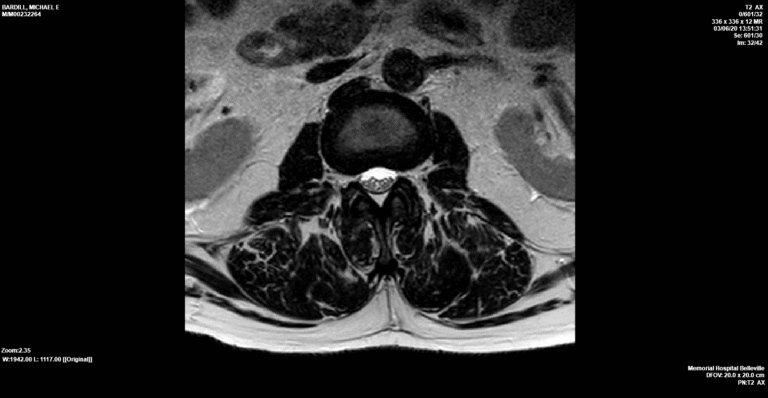
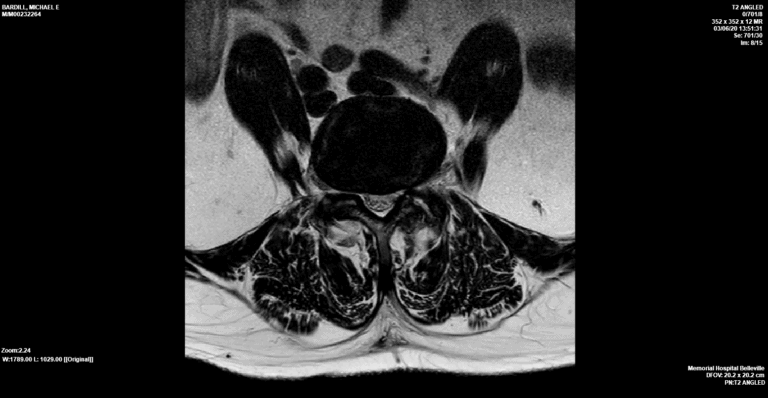
Lumbar spondylosis is a medical term that simply refers to arthritis, or degeneration of the joints in the lumbar spine. As we age, it is common to see arthritic changes in the lumbar spine and many of these are not significantly symptomatic. Some people will develop more severe degeneration of the joints in their lumbar spine with more consistent symptoms and seek treatment. Maintaining an ideal body weight and keeping your core muscles strong is the first line of treatment and if this is not done, the results of almost any other type of treatment will be quite limited. Physical therapy and daily core exercises are of benefit in some patients. For problems above and beyond that, patients will often see pain management physicians for injections. Our office often refers patients to physicians for evaluation for a rhizotomy (radiofrequency ablation). This is a procedure in which a pain management physician can use a thermal probe to ablate the small nerves that go to the joints in the back of the spine, so that the patient no longer feels the pain from those joints. We do not perform this procedure but often make referrals for it.
The vast majority of arthritis in the lumbar spine does not require surgical intervention. If a patient fails all nonoperative measures and has severe degeneration, surgical intervention can be performed in the form of a lumbar fusion. This will remove the arthritic pain generators from the levels that are operated on.
Lumbar Degenerative Spondylolisthesis
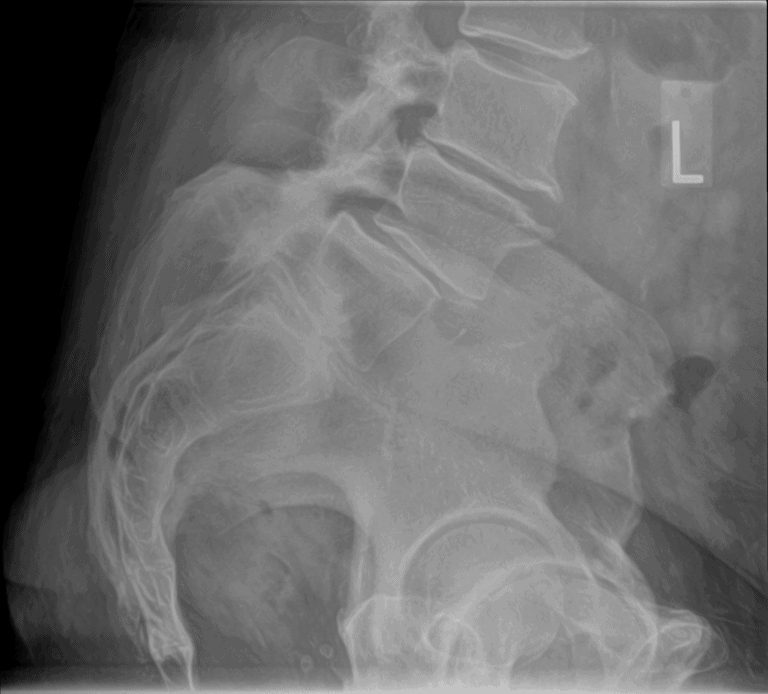
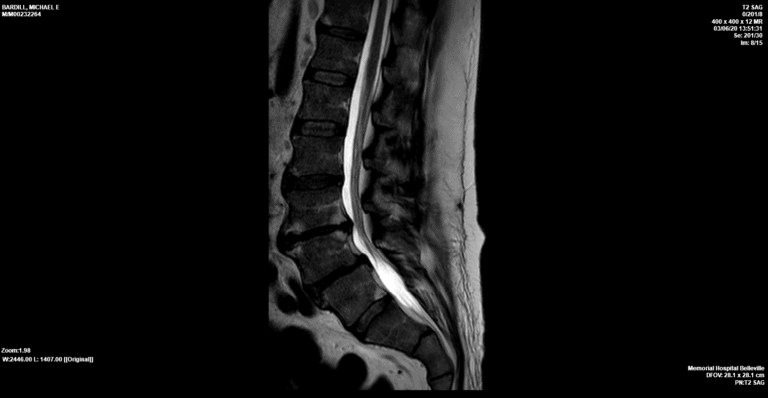
A lumbar degenerative spondylolisthesis is a common condition in which the joints in the back of the spine wear out. This leads to one bone sliding forward on another bone. As this occurs, this leads to narrowing of the nerve tunnels, which can cause pain into the buttock, and possibly into the legs. The condition can present many different ways. Symptoms may consist of mild back pain from the arthritic component, severe pain in the back, severe pain in the legs, or even weakness in the legs. The best way to understand this condition is to think of it as mild, moderate, or severe. In many ways, it is not that different than knee arthritis. People with mild knee arthritis often respond to physical therapy and an injection and do not need a knee replacement. People with severe degeneration of their knee joint that can only walk 100 feet before they have pain are probably not going to get better until they have a complete knee replacement. It is similar in patients with a lumbar degenerative spondylolisthesis. People with early/mild degeneration often respond to physical therapy, weight loss, core conditioning and possibly epidural steroid injections. People with severe erosion of the joints in the back of their spine with significant instability and 3 months of progressively worsening symptoms are very unlikely to have resolution of their symptoms without surgical intervention. The decision for surgery is based on combining the patient’s history, response to previous treatments and what is found on x-rays and advanced imaging studies. Many patients with this condition require a lumbar fusion for resolution of their symptoms. It is one of the more common reasons a lumbar fusion is performed in the United States.
Cervicalgia (Neck pain)
Neck pain is relatively common and most people will have an episode of neck pain in their lifetime. Most episodes of neck pain are self-limited and resolve on their own within 6 to 12 weeks, regardless of treatment. Patients that have neck pain that goes on for more than 3 months are more likely to have a structural problem that has led to their persistent symptoms. We find that the four most common causes of prolonged neck pain are disc degeneration, disc herniations, arthritis of the joints in the back of the spine (facet joints), and/or nerve impingement. If a patient who is interested in surgical treatment has pain in their neck without symptoms in their arms, a relatively complicated work-up is typically required to isolate where their pain is coming from. This is because degenerative changes on imaging do not always cause symptoms. Therefore, treatment is guided by imaging, symptoms, and the duration of symptoms. Surgical treatment of patients who have neck pain as their dominant complaint is considered controversial in the world of spinal surgery. Therefore, if a patient is seen by several spine surgeons, they will likely receive several, very different opinions. Our philosophy, in general, is to spend the time necessary to isolate what appears to be the primary pain generator. If the patient fails all appropriate nonoperative care, a surgical solution will be offered that focuses on those problems that are actually causing symptoms, as opposed to focusing on simple degenerative changes that are not symptomatic.
Lumbago (Low back pain)
Episodes of low back pain are extremely common and 90% of people will have a major episode of back pain in their lifetime. Most episodes of low back pain resolve on their own, within 6 to 12 weeks. If the patient has lower back pain without any symptoms into the legs, then we believe initial treatment does not require spinal surgery consultation. I would generally recommend that the patient ask their Primary Care Physician, for anti-inflammatory or steroid medication to help calm down the inflammation which leads to many episodes of back pain and to consider physical therapy. It is also important for the patient to understand that even though symptoms can be quite severe at first, it can be surprising how much resolution of symptoms happen on their own within a few weeks to a few months.
In patients that have back pain that continues to trend in a negative direction over several months, is intractable, or is persistent for greater than 3 months, I believe it is reasonable to obtain an MRI to try to reach a more definitive diagnosis. In our practice, we do not have one specific timeline for when it is appropriate to get an MRI, as every patient is different. In some people, they clearly do not require an MRI and others should have it performed much sooner than many guidelines recommend. Our goal is to obtain the appropriate imaging when it makes the most sense for the patient. The most important thing in treating chronic back pain is to first come up with the correct diagnosis, as treatment varies markedly depending on the primary cause. The most common causes of chronic lower back pain are arthritis of the joints, lumbar stenosis, and spinal instabilities like lumbar spondylolisthesis or disc degeneration. It is common to have these problems on an MRI Scan without them being the cause of the patient’s symptoms. Thus, there is need for a thorough evaluation to determine the exact origin of symptoms. Once a diagnosis has been obtained, we are in a much better position to determine if surgery is indicated.
Lumbar Disc Herniation
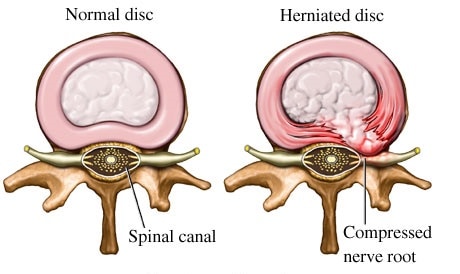
The lumbar disc is basically the cushion that sits between the bones of the lumbar spine, which provides stability and shock absorption. Over time, everybody’s discs degenerate to some degree and this is part of normal aging. A disc is made up of several parts, primarily a tough outer part and the soft inner core. A lumbar disc herniation is when the soft inner part pushes through the tough outer part. When the soft inner disc material pushes through the outer part and lands against a nerve, the patient can develop pain in the distribution of that nerve. Disc herniations can occur at any level in the spine but are most common in the lower lumbar spine. When this occurs, patients will often develop pain in the buttock going down into their legs. Many disc herniations improve without surgical intervention, as the natural history of many disc herniations are to improve on their own. Over time, the body can resorb or wall off the disc material that entered the spinal canal, at which time patient quits being symptomatic from it.
Surgical intervention is considered when a patient has a neurologic deficit from the disc herniation or significant discomfort that is failing to improve with nonoperative measures. Different disc herniations have what I would call different personalities; some are quite mild, and others are extremely severe. When it comes to surgical intervention, most disc herniations can be treated by a procedure known as a lumbar microdiscectomy. This is an out-patient procedure which has the goal of removing the herniated disc material. If a patient’s primary complaint prior to surgery is pain in the buttock and down the leg, the procedure has a very good success rate for relieving this. If a patient has a disc herniation in the central portion of the disc with a primary complaint of back pain, the results of a microdiscectomy are more variable, as some patients with this type disc herniation have pain coming from their disc herniation and others have it coming from structural damage to the disc itself. A lumbar microdiscectomy will not fix back pain from structural damage to the disc. The results of surgery on this type of disc herniation are best determined through a thorough discussion with a surgeon who knows the history of your disc herniation, the history of your back pain, and has reviewed your MRI images.
Cervical Strain/Whiplash
A cervical whiplash injury is when a hyperflexion or hyperextension event occurs to the cervical spine. This is commonly seen in motor vehicle accidents in which the patient is restrained by a seat belt and their vehicle is struck by another vehicle. The majority of whiplash injuries resolve on their own and healing might be accelerated by physical therapy. A small percentage of patients develop persistent neck pain that does not resolve. For those patients that have symptoms for more than a year, it is much less likely that they will improve on their own. This is often because there is some sort of structural injury to the cervical spine. Patients in this situation will find if they go to several different surgeons, that they will get a multitude of different opinions as to what to do, ranging from being told surgery cannot help to those who will suggest multi-level fusions with the hope of improving symptoms. In our practice, for those that clearly have symptoms that are not getting better, we do our best to use advanced diagnostics to isolate the origin of symptoms and see if there is a reasonable surgical option. If the primary pain generator can be identified, many patients may be candidates for cervical disc arthroplasty.
Lumbar Strain
A lumbar strain is an injury to the muscles or tendons of the lumbar spine secondary to a physical overload of the spine. Lumbar strains should improve on their own over 2 to 3 months. We often see patients who were told that they had a lumbar strain, however, they continued to have symptoms that lasted more than 3 months. In that case, we believe that it is less likely that the primary problem is a pulled muscle or tendon, and more likely some sort of structural injury to another part of the spine. Muscles and tendons would have healed within that time period. In a case of back pain in a patient who was previously told that it was simply a lumbar strain, further diagnostics are required to reach a true diagnosis.
Degenerative Disc Disease
Many patients say that they are suffering from degenerative disc disease and that they have a family history of it. The term degenerative disc disease is somewhat misleading in that everybody’s discs degenerate as they age. It is normal to have some degree of disc degeneration. What is important to know, is that most degenerated discs are not major pain generators and simply having a degenerated disc does not mean that this is the main cause of the patient’s symptoms. Knowing this, there are a number of people that do have symptomatic disc degeneration. Depending on the severity of symptoms, and lack of successful non-operative care, there are often surgical treatment options. As we age, everybody develops some degree of degeneration of the discs in their cervical and lumbar spine. This is part of normal aging.
Most disc degeneration is painless, or symptoms are relatively mild. There are, however, a subsection of patients who develop chronic neck or back pain that does not respond to physical therapy and/or pain management treatment. In those cases, some surgeons recommend surgical intervention, and some do not. Surgical treatment of cervical and lumbar disc degeneration is a controversial area in spine surgery. We believe in carefully selecting cases in which surgical intervention can be of benefit. However, the majority of degenerating discs do not require surgical intervention.
Cervical Myelopathy
Cervical myelopathy is a pathologic condition in which the patient develops compression of the spinal cord in their cervical spine. It is common to see varying degrees of compression of the spinal cord in the cervical spine. If patients are not symptomatic, we generally do not recommend surgical intervention, as we do not believe that the data supports automatically operating on a spinal cord compression. On the other hand, when a patient presents with symptoms of spinal cord compression (numbness, weakness in the arms or legs, decreased balance, or decreased hand coordination), we strongly recommend surgical intervention. The goal of surgery is to take pressure off the spinal cord and stop the progression of the neurologic loss. There is no guarantee of recovery of neurologic function after surgery. Patients who are treated earlier, often do significantly better. Thus, this is one of the areas of spinal surgery that we will be more aggressive in recommending surgical intervention. It should be noted that compression of the spinal cord is not necessarily a painful condition, which is different than many other spinal conditions.
Cervical Radiculopathy
Cervical radiculopathy is a condition in which patients have numbness, tingling, or weakness into their arms because of compression of the small nerve roots that grow off of the spinal cord forming the nerves that go down into the arms. Cervical radiculopathy is relatively common, and, in many cases, patients get better without surgical intervention. It is also common to see tightness or narrowed tunnels around the nerve roots as they leave the cervical spine, but this is not always symptomatic. Surgical treatment of cervical radiculopathy is very successful and is performed for patients that are developing a neurologic deficit or that have symptoms that persist or progressively worsen over time.
Lumbar Radiculopathy
Lumbar radiculopathy is a condition in which a patient develops symptoms from compression or inflammation of a nerve root in the lumbar spine. The most common symptoms are pain, numbness or tingling going through the buttock down into the legs. Some patients will present with weakness of varying degrees. The two most common causes of lumbar radiculopathy are lumbar disc herniations and lumbar stenosis. A large percentage of patients with symptoms from a disc herniation improve without surgical intervention, as many disc herniations can resorb over time. This leads to spontaneous improvement of symptoms. Nonoperative treatment is aimed at controlling symptoms while the body tries to heal itself. A lumbar microdiscectomy is performed for cases that are more severe and fail to have a good response to nonoperative care. Patients that have lumbar radiculopathy from lumbar spinal stenosis are less likely to have resolution of their symptoms with nonoperative care. Lumbar stenosis is caused by degenerative changes, which do not have a natural history of resorption. It should be noted that the patient with lumbar stenosis causing lumbar radiculopathy will at times improve without surgical intervention. Patients that have symptoms for more than 3 months on a consistent or worsening basis, are less likely to have long term resolution of their symptoms without surgical intervention.
Coccydynia (Tailbone pain)
Often a patient will come in telling us that they “broke their tailbone”. If indeed they fractured their sacrum or their coccyx, these bones will heal on their own while being uncomfortable for a few months. When a patient has fallen on their tailbone and has had symptoms for more than 3 months, it is less likely that it is from a fracture of the bone, and more likely that it is from an injury to the joint that connects the coccyx, or tailbone, to the sacrum. Nonoperative care for this consists of physical therapy and injections. Patients who have symptoms that go on for more than 6 months and have failed nonoperative treatment can be evaluated to see if they are a candidate for a coccygectomy. The structure that is causing the persistent pain is the joint, and by removing the coccyx, the painful joint is removed as well. This can be done because we do not need our coccyx or the sacrococcygeal joint. This is different than almost every other joint in the body, in which we need the joint to function properly. A coccygectomy is an outpatient procedure.
Bulging Discs
In general, we do not like the term bulging disc. It is not a good diagnostic term and is ambiguous. Many patients come in telling us that they have bulging discs and that is the source of their pain; however, this is an assumption.
The disc is made up of a softer inner part and a tougher outer part. When we are young, the middle part of the disc is well hydrated, making the discs tall. As we age, the middle of the disc can dehydrate causing loss of height. This causes the outer part of the disc to bow out. Think of a tire that is low on air and how the tire contacting the ground bows out at its edges. The tire itself is fine, it is simply low on air. A bulge of a disc develops because the disc has degenerated to some degree, and the outer part is bowing out.
This bowing out of the disc is significant when it causes narrowing of the nerve tunnels. There typically has to be other degenerative changes, along with the bulging of the disc, to cause compression of the nerves. When this occurs, we refer to it as lumbar spinal stenosis. Many patients have lumbar disc herniations and call them bulging discs, but these are really two different things. A disc herniation is a rupture of disc material through the outer part of the disc, known as the annulus, whereas a bulging disc has an intact annulus. The natural history of a disc herniation in many cases is to improve on its own. Once a disc has degenerated, it will always have a bulge, which is often not symptomatic.
Failed Back Syndrome/Surgery
There are multiple reasons a patient can undergo a surgery on their lumbar spine and not have a good outcome. In our practice, it is common for us to see a patient that had surgery previously, and still has persistent symptoms. One reason for this is when a patient had only decompressive surgery but would have done much better with a lumbar fusion. Patients who had a lumbar fusion that did not heal, a non-union, also experience this issue. Some patients had a successful surgery, and then developed a new problem at a different level, but assumed the problem was coming from the same place that their original pain came from. There are also cases of people that have disc herniations treated surgically, and then have another herniation at the same level, which has not yet been diagnosed. Additionally, there are patients that do not do their part to improve the health of their back. Choosing to maintain ideal body weight and strengthen core muscles can help avoid further issues postoperatively.
Other
Compression Fractures
Discogenic Neck and Back Pain